

Blog
What Do Peptides Do in the Body? A Simple Guide

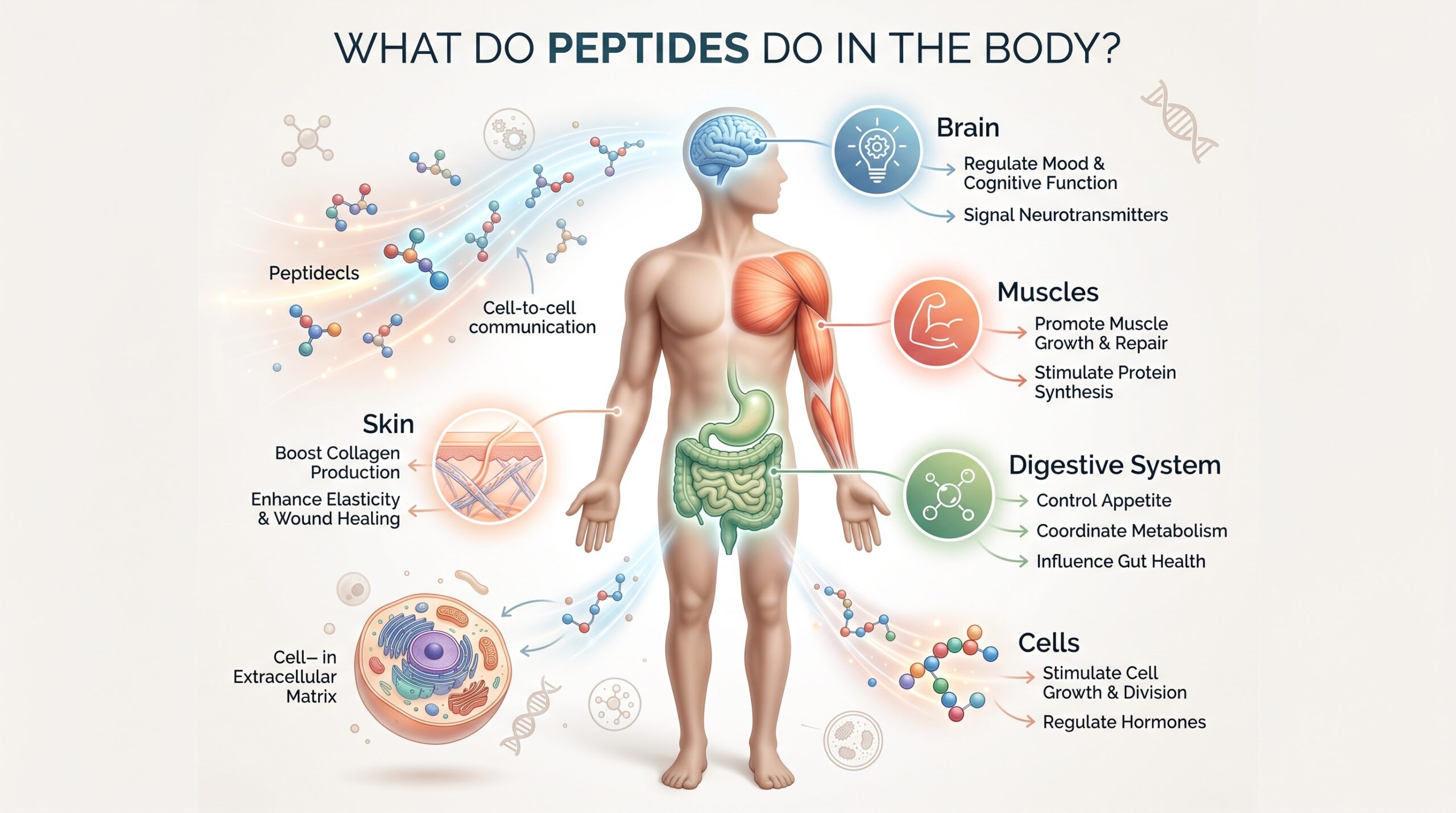
Peptides are small chains of amino acids that play many important roles in human biology. They can act as signals, hormones, messengers, and defense molecules. Because different peptides have different structures, they can affect different cells and biological processes.
So, what do peptides do in the body? The short answer is that peptides help cells communicate and regulate many normal functions, including metabolism, blood sugar control, appetite, digestion, growth, immune activity, and tissue processes.
Peptides are not one single type of substance with one single effect. Some are made naturally by the body, while others are produced for medicines or researched for other uses. Their effects depend on their amino acid sequence, structure, target, and how the body processes them.
Research shows that peptides can act as hormones and signaling molecules and can also participate in defense systems. Insulin and oxytocin, for example, are peptide hormones, while antimicrobial peptides can contribute to the body’s natural defenses.
Understanding what do peptides do in the body starts with understanding what a peptide actually is.
What Are Peptides?
A peptide is a molecule made from amino acids joined together by chemical bonds called peptide bonds. Amino acids are the basic building blocks used to make peptides and proteins.
The sequence of amino acids gives each peptide its particular shape and biological behavior. Even relatively small changes in a peptide’s sequence can change how it interacts with cells.
Peptides are generally shorter than proteins, although there is no single universal cutoff that perfectly separates the two. In biological research, peptides are often described as short amino acid chains, while proteins are usually larger and more complex structures.
Peptides vs. Proteins
Both peptides and proteins are built from amino acids.
The main difference is usually their size and structural complexity:
- Amino acids are individual building blocks.
- Peptides are relatively short chains of amino acids.
- Proteins are usually longer chains that fold into complex three-dimensional structures.
Imagine amino acids as individual letters. A peptide is like a short word made from those letters, while a protein may be more like a long sentence or book with several sections.
This comparison is only an analogy. In real biology, peptides and proteins have much more complex structures and functions.
Many peptides work as biological messengers. Some interact with receptors on cell surfaces, while others have structural, defensive, or regulatory roles.
How Peptides Are Made in the Body
The body makes many peptides through normal cellular processes.
Cells contain DNA, which stores instructions for making biological molecules. When a particular peptide is needed, genetic information can be used to produce a larger precursor molecule. Enzymes can then process that precursor into an active peptide.
This system allows the body to produce different signaling molecules in specific tissues and at appropriate times.
For example, some peptide hormones are produced in endocrine cells and released into the bloodstream. They can then travel to target tissues and influence specific biological processes.
This is one reason what do peptides do in the body has such a broad answer: different cells produce different peptides for different purposes.
What Do Peptides Do in the Body?
Peptides can perform many biological functions. Their actions depend on the specific peptide and its target.
Some act as chemical messengers between cells. Others act as hormones. Some influence metabolism, appetite, digestion, immunity, or tissue activity.
Here are some of the major roles that help explain what do peptides do in the body.
Support Cell Communication
One of the most important peptide functions is cell communication.
Cells need ways to send and receive information. Peptides can serve as chemical signals that carry information from one cell or tissue to another.
A signaling peptide may be released by one cell and then travel a short distance or enter the bloodstream. When it reaches a cell with the correct receptor, it can trigger a response.
The receptor works somewhat like a lock, while the peptide acts like a key. The peptide does not necessarily affect every cell. Instead, cells with the appropriate receptor are more likely to respond.
This communication system helps coordinate many body processes.
For example, a peptide signal might tell a cell to change its activity, release another substance, alter metabolism, or respond to a particular condition.
Regulate Hormone Functions
Some hormones are peptides.
Peptide hormones are chemical messengers produced by endocrine tissues. They can travel through the bloodstream and affect distant target cells.
Examples include insulin, glucagon, oxytocin, and several hormones involved in growth and reproductive functions.
Insulin, for example, helps regulate blood glucose. Glucagon has an opposing role in glucose regulation by helping raise blood glucose when it becomes too low.
These examples show why the question what do peptides do in the body cannot be answered with one simple function.
Different peptide hormones have different targets and effects.
Support Metabolism
Peptides also participate in metabolic regulation.
Metabolism refers to the chemical processes that allow the body to use, store, and produce energy. Several peptide signals influence glucose levels, appetite, digestion, and energy balance.
For example, peptide hormones can help the body respond to changes in food intake and blood glucose. Some peptide signals are released around meals and can influence digestion and appetite.
The result is a coordinated system rather than one isolated action.
The body constantly receives information about nutrients, energy availability, and digestive activity. Peptide signaling is one part of the communication network that helps respond to these changes.
Support Tissue and Cell Functions
Some peptides participate in processes involving tissues and cells.
Biological peptides can influence cell signaling pathways associated with growth, differentiation, repair, and other cellular activities. Different tissues may respond to different peptide signals.
The skin, muscles, bones, blood vessels, digestive system, and other tissues all depend on complex cellular communication.
However, this does not mean that taking a peptide product automatically improves tissue growth or repair. Natural biological functions and claims made about commercial products are not the same thing.
A peptide can have an important role in normal biology without a supplement containing that peptide having a proven benefit.
Help Regulate Immune Responses
Some peptides participate in immune signaling and defense.
Antimicrobial peptides, also called host-defense peptides, are part of innate immune defenses in many organisms. They can interact with microorganisms and may also influence immune responses.
Some naturally occurring human peptides are found in places such as skin and mucosal tissues, where they can contribute to protection against microbes.
This is another important part of understanding what do peptides do in the body.
However, naturally occurring immune peptides should not be confused with peptide-based medicines or products marketed for immune support. Their chemistry, dose, delivery, evidence, and safety can be very different.
Types of Peptides in the Human Body
There are many ways to classify peptides. Their biological role is often more useful than simply looking at their size.
Peptide Hormones
Peptide hormones are signaling molecules that help regulate body functions.
Examples include:
- Insulin
- Glucagon
- Oxytocin
- Vasopressin
- Parathyroid hormone
- Several hormones involved in growth and digestion
Each has a different role.
Insulin is involved in glucose regulation. Glucagon helps increase blood glucose when needed. Oxytocin participates in several physiological processes, including reproductive functions.
These examples show that peptide hormones are highly specialized.
Signaling Peptides
Signaling peptides help cells communicate.
They may interact with receptors on the surface of cells and activate signaling pathways inside those cells.
A peptide signal can produce effects such as changing enzyme activity, altering gene expression, modifying secretion, or changing cellular behavior.
Because signaling is highly specific, the same peptide does not necessarily produce the same effect in every tissue.
Antimicrobial Peptides
Antimicrobial peptides help form part of the body’s natural defense system.
They can act against certain microorganisms and may also influence immune activity. Research describes antimicrobial peptides as important components of innate immunity.
Their mechanisms vary. Some can interact with microbial membranes, while others affect microorganisms through different pathways.
Researchers are studying these molecules because of their potential applications in medicine, but many research findings do not automatically translate into approved treatments.
Structural and Functional Peptides
Some peptides have roles that do not fit neatly into the categories of hormones or antimicrobial molecules.
Peptides can interact with proteins, receptors, membranes, enzymes, and other biological structures. Some help regulate cellular pathways, while others may be produced when larger proteins are processed.
This wide range of functions explains why peptides are studied in fields such as endocrinology, immunology, molecular biology, and pharmacology.
How Peptides Work in the Body
To understand what do peptides do in the body, it helps to look at what happens after a peptide reaches its target.
Peptides Bind to Receptors
Many signaling peptides work by binding to receptors.
A receptor is a protein that recognizes a particular signal. When the appropriate peptide binds to its receptor, the receptor can change shape or activity.
This starts a chain of events inside the cell.
Different receptors activate different signaling pathways. Some peptide receptors are located on the cell surface because many peptides cannot easily cross the cell membrane.
The interaction is often highly specific.
Peptides Trigger Cellular Responses
After a peptide binds to a receptor, the cell may respond in several ways.
For example, the signal may:
- Change enzyme activity
- Alter the release of another molecule
- Affect nutrient use
- Change cellular communication
- Influence gene activity
- Modify cell behavior
The exact response depends on the peptide, receptor, tissue, and biological context.
This is why it is inaccurate to say that all peptides “boost” the body or produce one universal effect.
Peptide biology is much more specific.
Peptides Are Broken Down After Signaling
Peptides do not normally remain active forever.
The body has systems that break down and clear signaling molecules. Enzymes can break peptide chains into smaller fragments and amino acids.
The kidneys, liver, blood, and other tissues can contribute to the processing and removal of peptide molecules, depending on the specific peptide.
This helps control the strength and duration of peptide signals.
In other words, the body needs both signaling and signal termination.
Peptides and Important Body Functions
The broad answer to what do peptides do in the body becomes clearer when we look at specific physiological functions.
Blood Sugar Regulation
Several peptide hormones are involved in maintaining blood glucose within an appropriate range.
Insulin helps cells take up and use glucose and supports storage of energy. Glucagon helps the body increase blood glucose when it needs more circulating fuel.
Other peptide signals released by the digestive system can also influence insulin release and metabolic responses after eating.
This is a coordinated process involving the pancreas, digestive tract, liver, muscles, fat tissue, and nervous system.
The goal is not simply to make blood sugar lower or higher. The body needs to regulate glucose according to its current needs.
Appetite and Digestion
Peptide signals are also involved in hunger, fullness, and digestive function.
The digestive tract releases signaling molecules in response to food. These signals can affect stomach activity, pancreatic function, intestinal movement, insulin release, and communication between the digestive system and brain.
Some peptide signals are associated with increased hunger, while others contribute to feelings of fullness.
Because appetite involves many overlapping systems, no single peptide explains hunger or body weight by itself.
This is an important point when considering what do peptides do in the body.
Growth and Development
Some peptide hormones are involved in growth and development.
Growth-related signaling involves multiple hormones, receptors, organs, and tissues. Peptide hormones can participate in pathways that influence bone, muscle, and other tissues.
The effects depend on age, development, genetics, nutrition, hormone levels, and overall health.
A naturally occurring growth-related peptide signal should not be confused with a product marketed online for increasing height, muscle, or other physical traits.
Skin and Connective Tissue
Peptides also have roles in tissue biology.
The skin contains many types of cells that communicate through signaling molecules. Peptides can participate in processes related to cell communication, inflammation, and tissue maintenance.
Collagen itself is a protein rather than a peptide, although collagen can be broken into smaller peptide fragments.
This distinction matters because cosmetic and supplement marketing sometimes uses the word “peptide” very broadly.
Laboratory evidence that a peptide affects a cell does not automatically prove that applying or consuming a commercial peptide product will produce the same effect in people.
What Is the Difference Between Natural Peptides and Peptide Supplements?
Natural peptides and commercial peptide products should not be treated as identical.
Peptides Naturally Produced by the Body
The human body naturally produces many peptides.
Examples include peptide hormones and signaling molecules involved in metabolism, digestion, immune activity, and other processes.
These peptides are produced in regulated biological systems.
The body controls when they are produced, where they are released, how they interact with receptors, and how they are broken down.
That is very different from taking an external product.
Peptides Used in Supplements
Some products marketed as peptide supplements contain peptide-derived ingredients or proteins that are broken into smaller peptide chains.
Collagen peptides are one example of a dietary ingredient commonly sold in supplement products.
However, the presence of a peptide does not prove that a product will produce a specific health effect.
Claims about supplements should be evaluated based on human evidence, the exact ingredient, product quality, and the intended use.
A product may also contain ingredients besides the peptide itself.
For these reasons, consumers should be cautious about broad claims that a peptide product will dramatically change hormones, metabolism, muscle, skin, or other body functions.
Peptide-Based Medicines
Some medicines are based on peptides or peptide-like molecules.
These products can be designed to imitate, modify, or block natural biological signals.
Approved peptide medicines are evaluated for their specific medical uses, including safety, effectiveness, manufacturing quality, and appropriate dosing.
The FDA maintains information about approved medicines and their labeling through resources such as Drugs@FDA.
Because prescription peptide medicines can have significant effects on the body, they should be used only according to qualified medical guidance.
The fact that a peptide occurs naturally in the body does not mean that an externally supplied version is automatically safe or appropriate.
Do Peptides Have Side Effects?
The answer depends on which peptide is being discussed.
Naturally Occurring Peptides
Naturally occurring peptides are normal parts of human biology.
Their presence alone does not mean they are harmful. The body makes and regulates many peptides as part of normal physiology.
However, abnormal levels of a naturally occurring peptide can sometimes be associated with disease or other biological problems.
So, “natural” does not always mean “safe in every amount or situation.”
Peptide Supplements and Products
The safety of a commercial peptide product depends on the specific ingredient, formulation, manufacturing quality, amount used, and individual circumstances.
Products sold as supplements may not have the same evidence or regulatory pathway as prescription medicines.
There can also be concerns about inaccurate labeling, contamination, interactions, or unsupported claims.
People should avoid assuming that a product is safe simply because its name contains the word “peptide.”
Prescription Peptide Medicines
Prescription peptide medicines can have side effects, just like other medicines.
The possible effects depend on the specific medicine, its target, dose, route of administration, other medicines being taken, and the person’s health.
For this reason, peptide medicines should be used under appropriate medical supervision.
The FDA notes that peptide drug development involves considerations such as pharmacokinetics, drug interactions, safety, and immunogenicity.
Current FDA guidance and product information also show that multiple peptide medicines are being evaluated and regulated as specific pharmaceutical products rather than as one general category.
FAQ
What do peptides do in the body?
Peptides perform many different biological functions. They can act as hormones, signaling molecules, immune-defense molecules, and regulators of cellular activity. Their exact function depends on their amino acid sequence and biological target.
Are peptides naturally found in the body?
Yes. The human body naturally produces many peptides. They are involved in processes such as hormone signaling, metabolism, digestion, immune defense, and cellular communication.
Are peptides the same as proteins?
No. Peptides and proteins are both made from amino acids, but peptides are generally shorter and less structurally complex. The boundary between peptides and proteins is not based on one universal chain length.
How do peptides communicate with cells?
Many peptides communicate by binding to receptors. The receptor recognizes the peptide and can start a signaling pathway inside the target cell. This allows one cell or tissue to send information to another.
Do peptides affect hormones?
Yes. Some peptides are hormones themselves, while other peptides influence hormone release or hormone-related signaling. Insulin and glucagon are examples of peptide hormones involved in metabolic regulation.
Do peptides help with metabolism?
Certain peptides play important roles in metabolism. They can influence blood glucose, appetite, digestion, insulin release, energy use, and other metabolic processes.
However, the effect depends on the specific peptide and biological context.
Are peptide supplements safe?
Safety depends on the specific product and ingredient. A supplement containing a peptide should not automatically be considered equivalent to a naturally occurring peptide or an approved medicine. Product quality and evidence also matter.
For therapeutic products, medical guidance is important.
How are peptides different from amino acids?
Amino acids are individual building blocks. Peptides are chains made from multiple amino acids joined together. Proteins are generally larger and more complex chains made from amino acids.
What do peptides do in the body compared with proteins?
Peptides and proteins can both participate in biological processes, but their functions differ based on their structures. Some peptides act mainly as signals, while proteins can perform structural, enzymatic, transport, immune, and many other functions.
Can peptides affect blood sugar?
Yes. Several peptide hormones participate in glucose regulation. Insulin helps lower circulating blood glucose by promoting glucose uptake and storage, while glucagon helps raise blood glucose when needed.
Do peptides affect appetite?
Some peptide signals released by the digestive system and other tissues influence hunger and fullness. These signals communicate with the brain and digestive organs as part of a larger appetite-control system.
Are collagen peptides the same as peptide hormones?
No. Collagen peptides are smaller fragments derived from collagen protein and are commonly used as dietary ingredients. Peptide hormones are biological signaling molecules with specific receptors and physiological functions.
Are all peptides beneficial?
No. Peptides are a broad group of molecules. Their effects depend on their structure, target, concentration, and biological context. Some peptides have useful physiological roles, while others may have harmful effects or be used as medicines with specific risks.
Why are peptides important in medicine?
Peptides can interact with biological targets with high specificity, which makes some of them useful as medicines. Pharmaceutical researchers can design or modify peptides to influence particular receptors or biological pathways.
How does the body remove peptides?
The body uses enzymes and organs involved in metabolism and clearance to break down and remove peptides. The exact process depends on the peptide’s structure and where it is produced or administered.
Final Thoughts
So, what do peptides do in the body? They help the body communicate, regulate, and coordinate many biological processes.
Peptides can act as hormones, signaling molecules, immune-defense compounds, and regulators of cellular activity. They can influence blood sugar, appetite, digestion, growth-related processes, tissue biology, and immune responses.
The most important point is that peptides are not one single type of substance with one universal effect. Each peptide has its own structure, target, biological pathway, and potential effects.
Naturally produced peptides are part of normal human physiology. Peptide supplements are a separate category and should be judged according to the evidence for the specific product and ingredient. Prescription peptide medicines are another category and require appropriate medical supervision.
Understanding what do peptides do in the body therefore requires looking at the specific peptide rather than making broad claims about all peptides.
In simple terms, peptides are small biological molecules that help cells communicate and help the body regulate important functions. Their roles are diverse, and ongoing research continues to clarify how individual peptides work and how some can be used safely in medicine.











