

Blog
How Much Collagen Peptides Per Day? A Simple Guide

Collagen is a protein that helps provide structure and support throughout the body. It is found in the skin, bones, tendons, ligaments, cartilage and other connective tissues. As people learn more about collagen, supplements containing hydrolyzed collagen or collagen peptides have become popular.
One of the most common questions is how much collagen peptides per day a person should take.
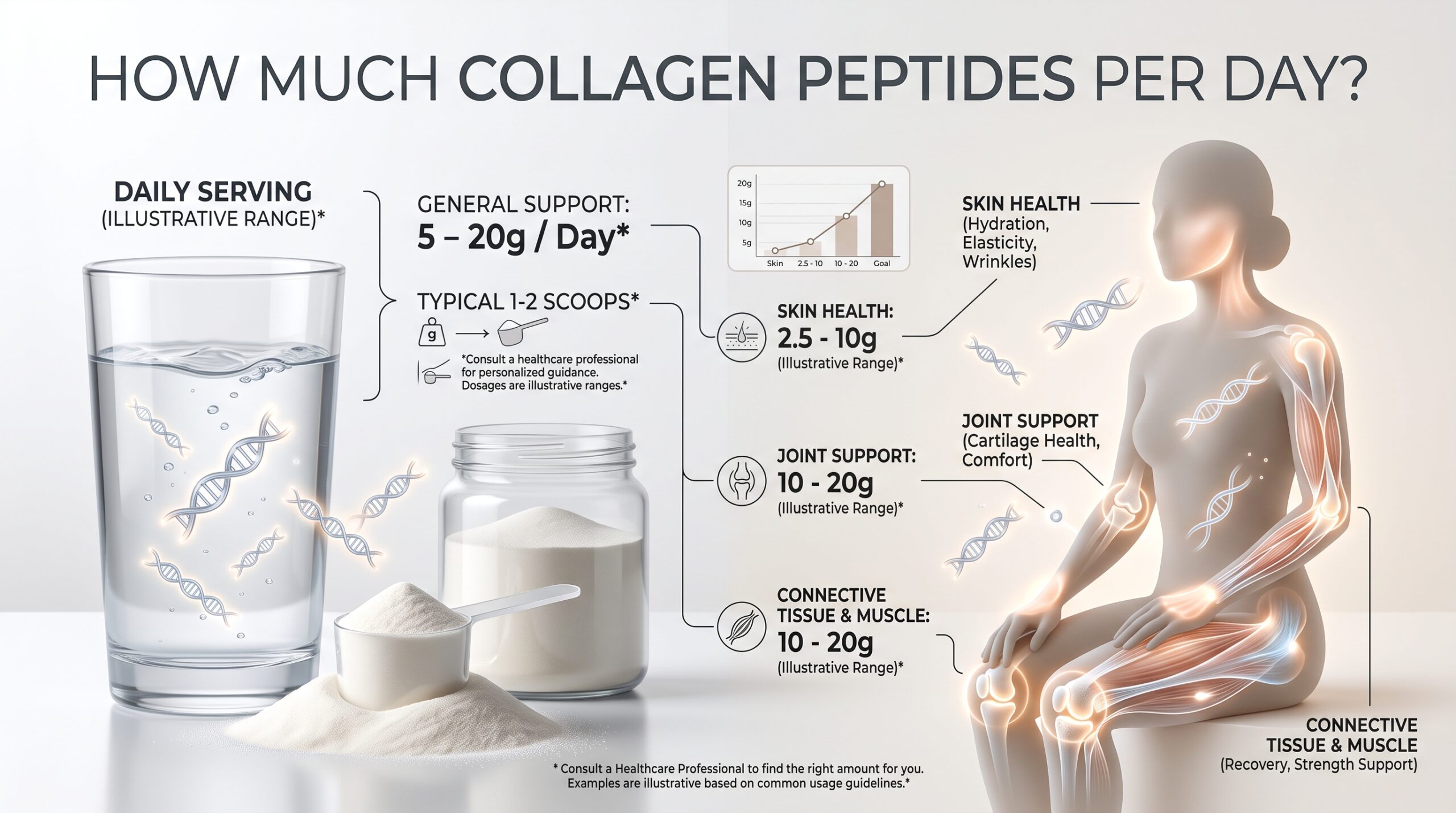
There is no single amount that works for everyone. Research has used different doses, and supplement products also come with different serving sizes. Common amounts found in collagen products and clinical studies range from about 2.5 grams to 15 grams per day. Cleveland Clinic notes that doses in this range are generally considered safe for many people when used appropriately.
For many adults, following the serving size on a reputable product is a practical starting point. Your reason for taking collagen, overall diet, allergies, health conditions and other supplements can also matter.
This guide explains how much collagen peptides per day is commonly used, what collagen peptides are, how people use them, potential benefits, possible side effects and when it is wise to speak with a healthcare professional.
How Much Collagen Peptides Per Day?
The answer to how much collagen peptides per day depends on the product and the goal for supplementation.
Research has tested a variety of amounts. Some studies have used around 2.5 grams daily, while other studies have used 5, 10 or more grams. Cleveland Clinic reports that collagen peptide doses between 2.5 and 15 grams per day are generally considered safe for many people.
A 2026 clinical trial examining bioactive collagen peptides for skin health compared 2.5 grams and 10 grams per day for 12 weeks. Both groups showed improvements in some skin measures, although the study used a specific collagen product and population, so the results should not be treated as a universal dose recommendation.
Typical Daily Collagen Peptide Amount
When asking how much collagen peptides per day, it helps to look at the serving size rather than simply choosing the largest possible amount.
Many collagen powders provide a serving somewhere within the commonly studied range. For example, a product might provide 5 grams per scoop, while another may provide 10 grams.
The label should tell you:
- The amount of collagen peptides per serving
- The serving size
- The collagen source
- Other ingredients
- Allergen information
- Directions for use
If a product says one scoop provides 10 grams of collagen peptides, taking two scoops would provide 20 grams. That is not automatically better.
More supplementation does not necessarily mean greater benefits. It is usually more sensible to follow the manufacturer’s directions unless a healthcare professional has recommended something different.
When considering how much collagen peptides per day, remember that supplement research does not establish one universal amount for every person.
Can You Take Collagen Peptides Every Day?
For adults who choose to use collagen supplements, daily use is common. Some clinical studies have provided collagen peptides every day for several weeks or months.
Consistency may be more relevant than choosing a specific time of day. However, collagen should be viewed as a supplement to a balanced diet rather than a replacement for good nutrition.
Your body needs many nutrients to maintain normal tissues and make proteins. A healthy diet can provide protein, vitamin C, minerals and other nutrients involved in normal collagen production.
If you are wondering how much collagen peptides per day you should take every day, start by checking the product directions and consider your overall dietary protein intake.
What Are Collagen Peptides?
Collagen is the body’s most abundant protein. It provides structural support for tissues such as skin, bones, tendons, ligaments and other connective tissues.
Collagen peptides are smaller pieces of collagen created through a process called hydrolysis. You may also see them called:
- Hydrolyzed collagen
- Collagen hydrolysate
- Hydrolyzed collagen peptides
Breaking collagen into smaller peptides makes the supplement easier to mix and digest.
Most collagen supplements come from animal sources. Common sources include:
- Bovine collagen from cows
- Porcine collagen from pigs
- Marine collagen from fish
The source matters if you have food allergies or follow a particular dietary pattern. For example, a marine collagen product may not be appropriate for someone with a fish allergy.
It is also important to understand that eating collagen does not mean the collagen travels directly to your skin or joints. Your digestive system breaks dietary proteins and peptides down, and the body uses the resulting amino acids and peptides according to its needs.
That is one reason how much collagen peptides per day cannot be answered simply by saying that a certain amount will go directly to a particular body part.
Why Do People Take Collagen Peptides?
People use collagen peptides for several reasons. Skin appearance and joint support are among the most common.
Research is still developing, and results vary between studies. Some recent reviews have reported potentially favorable effects, while also noting limitations such as study quality, differences between products and variation in study design.
Skin Support
Collagen is an important structural component of the skin. It helps provide strength and support to the dermis.
As people age, natural collagen production changes. Factors such as aging, sun exposure and lifestyle can also affect skin structure.
Some research suggests oral hydrolyzed collagen may improve certain measures of skin hydration, elasticity and wrinkle appearance. A 2026 systematic review of randomized controlled trials found improvements in several skin outcomes across many studies, but also noted that many trials had a high risk of bias and that better research is still needed.
Another 2026 umbrella review covering multiple systematic reviews reported favorable associations between collagen supplementation and some skin and musculoskeletal outcomes. However, researchers continue to call for stronger and more standardized evidence.
Therefore, how much collagen peptides per day should not be based on the assumption that a larger dose will automatically produce better skin.
Joint and Bone Support
Collagen is also found in cartilage, tendons, ligaments and bones.
Some studies suggest collagen supplementation may support joint comfort or function, particularly in people with certain joint problems. However, the evidence is not strong enough to treat collagen as a replacement for medical care.
Collagen may be studied as part of a broader approach that includes exercise, appropriate nutrition and medical treatment when necessary.
For people interested in joint support, how much collagen peptides per day may depend on the specific product and the dose used in research.
It is important to remember that supplements should not be used to delay evaluation of persistent joint pain, swelling, weakness or injury.
Muscle and Protein Intake
Collagen peptides contain protein, so they can contribute to total daily protein intake.
However, collagen is not the same as a complete dietary protein source. Collagen has a different amino acid profile from proteins found in foods such as eggs, dairy, fish, meat and many plant protein combinations.
For someone trying to build or maintain muscle, a balanced protein intake is important. Resistance exercise and adequate overall nutrition also matter.
So, how much collagen peptides per day should not be viewed as the same question as how much total protein you need.
Collagen can supplement a diet, but it should not automatically replace higher-quality complete protein sources.
Factors That May Affect Your Daily Collagen Intake
Several factors can influence how someone approaches collagen supplementation.
Your Health and Nutrition
Your overall diet matters.
If your diet already provides enough protein and a wide variety of nutritious foods, collagen may simply be an optional supplement.
A balanced diet can provide amino acids and nutrients needed for normal protein production. Foods such as fish, eggs, dairy, beans, meat, vegetables, fruits and whole grains can all contribute to overall nutrition.
If you have a restricted diet, digestive condition or other nutritional concern, speak with a qualified healthcare professional before making major supplement changes.
The question of how much collagen peptides per day should therefore be considered in the context of your whole diet rather than in isolation.
Your Reason for Taking Collagen
The purpose of supplementation can also influence the amount people consider.
Someone interested in skin health may look at studies involving hydration, elasticity or wrinkles.
Someone interested in joint support may be more interested in research involving joint comfort or function.
Someone simply looking for extra protein may need to compare collagen with other protein-rich foods and supplements.
These are different goals, so there is no reason to assume the same amount will be appropriate for everyone.
When considering how much collagen peptides per day, focus on the specific purpose rather than assuming more is always better.
The Collagen Product You Choose
Products can vary considerably.
Check the label for:
- Collagen amount per serving
- Collagen source
- Serving size
- Added sweeteners
- Flavors
- Vitamins or minerals
- Other active ingredients
- Potential allergens
Some products contain only collagen peptides, while others contain several additional ingredients.
The amount of collagen in one scoop can also differ from one product to another.
This is why you should check the label before deciding how much collagen peptides per day you are actually consuming.
Product quality also matters. Dietary supplements are not regulated in exactly the same way as prescription medicines. Cleveland Clinic notes that consumers should pay attention to product quality and labeling when choosing collagen supplements.
When Is the Best Time to Take Collagen Peptides?
There is no strong reason for most people to believe that collagen must be taken at one specific hour.
You can take collagen in the morning, afternoon or evening.
For many people, the easiest time is simply when they are most likely to remember it.
For example, someone might mix it into a morning drink. Another person may prefer adding it to yogurt after lunch.
The most important practical point is consistency with the product’s directions.
There is also no universal requirement to take collagen with food. Many collagen powders can be mixed into drinks or foods.
If a specific product has special instructions, follow those instructions.
So, when asking how much collagen peptides per day, timing is usually a secondary question. The amount, product directions, overall diet and individual circumstances are more important.
How to Take Collagen Peptides
Collagen peptides are often sold as powders because they are easy to mix into different foods and drinks.
Mix Collagen Into Drinks
One of the easiest options is water.
You can also mix collagen powder into:
- Coffee
- Tea
- Smoothies
- Milk
- Other suitable beverages
Some collagen powders dissolve more easily than others. Follow the product directions for mixing.
If you are adding collagen to hot coffee or tea, check the manufacturer’s instructions.
Add Collagen to Foods
Collagen peptides can also be mixed into foods.
Common options include:
- Yogurt
- Oatmeal
- Smoothies
- Soups
- Some baked or cooked foods
The exact use depends on the product.
For example, a person could mix a serving into yogurt at breakfast. Another person could add it to a smoothie after exercise.
This flexibility can make it easier to follow a consistent routine without treating the supplement as a separate meal.
When deciding how much collagen peptides per day, remember to count all servings you take throughout the day. If a powder contains 10 grams per serving and you use two servings, your total is 20 grams.
Can You Take Too Much Collagen Peptides?
More is not always better.
Collagen supplements can cause unwanted digestive symptoms in some people. Cleveland Clinic lists possible symptoms such as bloating, fullness, diarrhea and other mild gastrointestinal effects.
Taking more than the label recommends may also make the supplement unnecessarily expensive without providing a proven additional benefit.
For this reason, avoid treating how much collagen peptides per day as a competition to reach the highest possible number.
Instead, use the product according to its directions.
If you experience persistent digestive symptoms, an allergic reaction or another concerning symptom after taking a supplement, stop using it and seek appropriate medical advice.
Anyone with a medical condition, food allergy or complex medication routine should consider talking with a healthcare professional before starting a new supplement.
Are Collagen Peptides Safe for Everyone?
Collagen peptides are generally tolerated by many adults, but that does not mean they are suitable for everyone.
Your individual health situation matters.
Possible Side Effects
Some people may experience mild digestive symptoms after taking collagen supplements.
Possible problems can include:
- Bloating
- Fullness
- Diarrhea
- Unpleasant taste
- Unwanted texture
The ingredients besides collagen can also cause problems.
For example, flavored powders may contain sweeteners, flavoring agents or other ingredients that do not agree with everyone.
Allergic reactions are another important consideration.
Because collagen can come from fish, cows or pigs, check the source carefully if you have a relevant food allergy. Cleveland Clinic specifically warns that marine collagen may not be appropriate for people with fish allergies.
If you notice signs of a serious allergic reaction, seek urgent medical care.
Who Should Talk to a Healthcare Professional First?
Talk with a healthcare professional before using collagen supplements if you:
- Have a known food allergy
- Have a medical condition
- Follow a medically restricted diet
- Take prescription medicines
- Take several supplements
- Are pregnant or breastfeeding
- Are unsure whether a supplement is appropriate for you
A healthcare professional can consider your personal situation instead of giving a generic answer to how much collagen peptides per day.
This is especially important because supplements can contain ingredients beyond the main ingredient listed on the front of the package.
Collagen Peptides vs. Other Protein Supplements
Collagen peptides are a source of protein, but they are different from many common protein supplements.
Whey, milk and many other complete proteins provide a broader range of essential amino acids. Collagen is especially rich in amino acids such as glycine, proline and hydroxyproline.
This difference matters if your main goal is supporting muscle protein synthesis and meeting total protein needs.
For example, an athlete may use a complete protein source to help meet overall protein requirements while using collagen separately for a specific reason.
Collagen should therefore be viewed as a supplemental protein rather than a universal replacement for other protein foods.
The best choice depends on the person’s diet, nutritional goals, tolerance and health needs.
If you are mainly interested in collagen, the question of how much collagen peptides per day is only one part of the decision. You should also ask whether collagen is the right type of protein for your goal.
Frequently Asked Questions About Collagen Peptides
How much collagen peptides per day is recommended?
There is no single recommended amount for everyone.
Studies and commercial products commonly use amounts ranging from about 2.5 to 15 grams per day. Cleveland Clinic reports that 2.5 to 15 grams per day is generally considered safe for many people.
A practical approach is to follow the serving instructions on a reputable product rather than choosing a very high dose.
Your health, diet, allergies and reason for supplementation may also affect the appropriate amount.
Is 10 grams of collagen peptides a day enough?
Ten grams is an amount used in clinical research, including a 2026 study involving skin health. However, that does not mean 10 grams is required for everyone.
Some studies have used lower amounts, while products may recommend different serving sizes.
Therefore, how much collagen peptides per day should not automatically be answered with 10 grams for every person.
Can I take collagen peptides twice a day?
Some products may allow more than one serving per day, but you should follow the product’s directions.
For example, if one serving contains 5 grams and the label recommends one serving daily, taking two servings would double your intake.
There is not enough evidence to say that splitting collagen into two daily servings is automatically better than taking one serving.
If you are considering multiple servings, check the total amount and discuss it with a healthcare professional if you have health concerns.
Should I take collagen peptides with food?
Collagen peptides do not generally need to be taken with a particular meal.
You can mix them into drinks or suitable foods depending on the product.
Some people prefer taking collagen with breakfast because it is easy to remember. Others may take it later in the day.
The best routine is one that fits your normal schedule and follows the product instructions.
How long does it take to notice results from collagen peptides?
There is no guaranteed timeline.
Clinical studies often measure outcomes after several weeks or months rather than after only a few days.
For example, the 2026 skin study involving 2.5 and 10 grams of collagen peptides evaluated participants after 12 weeks.
Cleveland Clinic also notes that people who choose to try collagen supplements may need several months before noticing changes, while emphasizing that results are not guaranteed.
This means patience is important.
Can I take collagen peptides every day?
Many adults use collagen peptides daily, and daily supplementation has been studied.
However, you should follow the serving instructions and consider your overall diet.
If you experience unwanted symptoms, do not simply increase or continue the supplement without considering the possible cause.
The appropriate answer to how much collagen peptides per day depends on the individual and the product.
Are collagen peptides a good source of protein?
Collagen peptides do provide protein, but they should not necessarily replace complete protein sources.
Collagen has a different amino acid profile from proteins such as eggs, dairy, meat, fish and many well-planned plant protein combinations.
If your main goal is meeting your total protein needs, consider your complete diet rather than relying heavily on collagen.
Final Thoughts
So, how much collagen peptides per day is appropriate?
For many adults, commonly studied amounts fall within roughly 2.5 to 15 grams per day, and many commercial products provide servings within that range.
A dose around 10 grams has also been used in clinical research, but it is not a universal requirement. Lower amounts have been studied as well.
The right amount depends on the product, your reason for using collagen, your overall diet, allergies and individual health needs.
Rather than automatically choosing the highest dose, check the label, use a reputable product and keep your overall diet balanced. Collagen can provide supplemental protein, but it should not replace a varied diet or complete protein sources.
Research on collagen peptides is promising in some areas, particularly skin and musculoskeletal health, but the evidence is still developing and study quality varies.
If you have a medical condition, food allergy, special dietary need or take medications, ask a healthcare professional before starting a new supplement.
In short, how much collagen peptides per day is usually best approached as a product- and person-specific question, with commonly studied amounts around 2.5–15 grams daily rather than one fixed dose for everyone.
Related Posts

How Much 5-Amino-1MQ Should I Take? Safety Guide

The question “How Much 5 Amino 1MQ Should I Take?” has become increasingly common among people interested in metabolic health, body com...

What Is 5 Amino 1MQ Used For? Benefits and Risks
5 Amino 1MQhas attracted attention in scientific discussions about metabolism, fat tissue, and the biological processes that regulate h...

Does 5-Amino-1MQ Work? Benefits, Research & Safety
5-Amino-1MQ is a small molecule research compound that has drawn significant attention in the fields of metabolic science and cellular ...

What Is 5 Amino 1MQ? Uses, Benefits, and Risks
In recent years, conversations surrounding metabolic health, cellular aging, and weight management have expanded well beyond traditiona...

How Long Does Semax Injection Take to Work? A Guide
Semax is a synthetic peptide that has attracted considerable attention in both experimental neuroscience and wellness cir...

How to Take Semax: Safety, Uses, and What to Know
Semax is a synthetic peptide that has attracted considerable attention in neurobiology and clinical pharmacology due to its potential i...

How Does Semax Work? The Science Behind the Brain Peptide
Mental fatigue, declining focus, and slow cognitive recovery have pushed modern neuroscience to look far beyond traditional stimulants....

How to Make Semax Nasal Spray: Safety and Key Facts
Semax nasal spray has attracted attention because of interest in peptides and their possible effects on brain function. Semax is a synt...

What Does Selank Do? Uses, Benefits, and Risks
Selank is a synthetic peptide that has attracted scientific interest because of its proposed effects on anxiety, stress responses, and ...

What Is Selank Peptide Used For? Benefits and Risks
Selank peptide has attracted scientific interest because of its possible effects on anxiety, stress responses, and cognitive function. ...

GHK Cu Serum for Skin: Benefits, Uses, and Tips
GHK Cu is a copper-binding peptide that has attracted attention in modern skincare. It is also called copper tripeptide-1 and is made f...

What Are Peptides Steroids? Key Differences Explained
If you have searched for what are peptides steroids, you may be wondering whether peptides are simply another type of steroid. They are...