

Blog
What Peptides Are FDA Approved? A Complete Guide

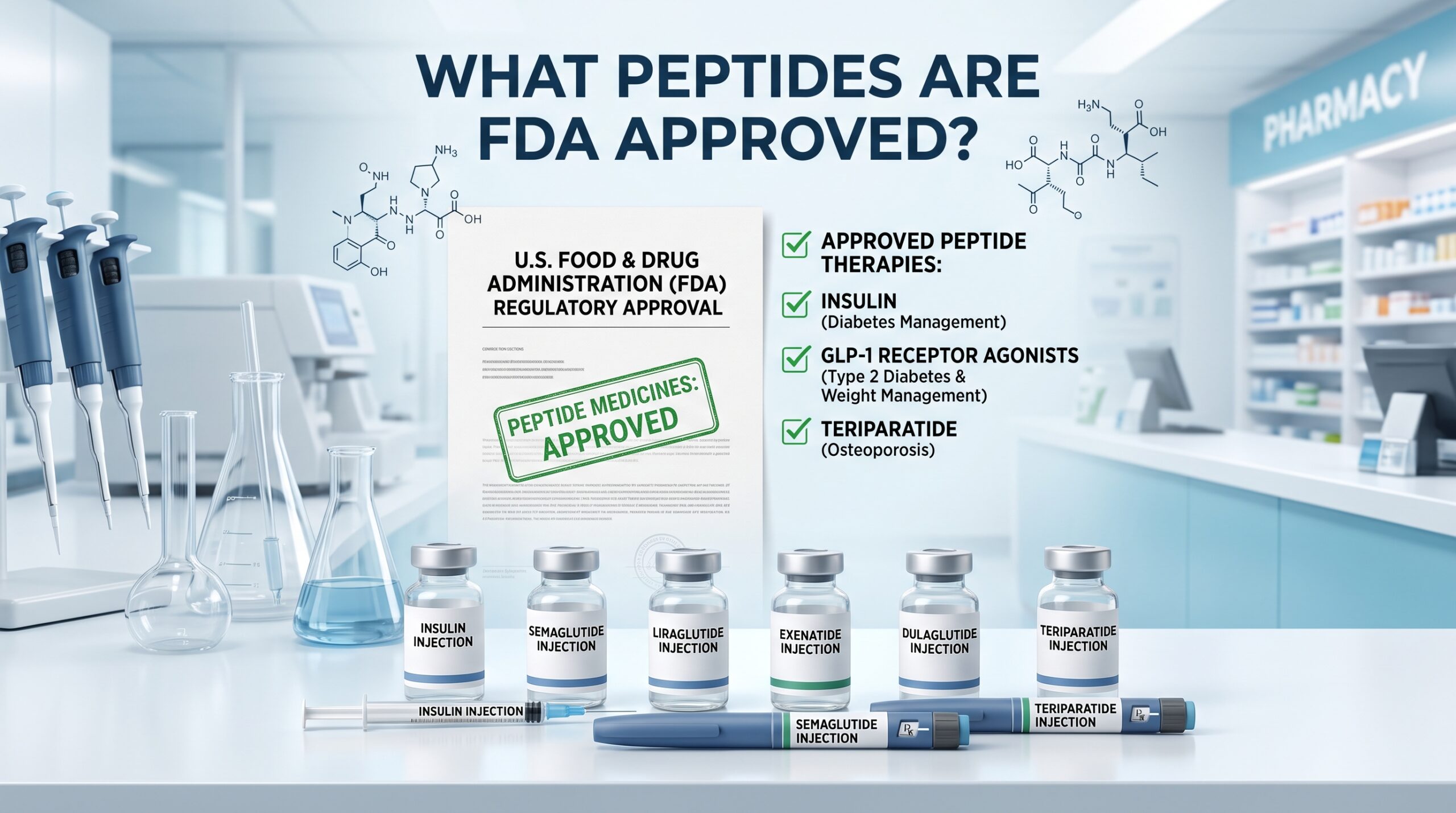
If you are researching what peptides are FDA approved, it is important to understand that the FDA does not approve a peptide simply because the molecule itself exists or has been studied. Approval applies to a specific drug product, formulation, and medical use.
The U.S. Food and Drug Administration (FDA) has approved several peptide-based medicines. These include well-known medicines such as semaglutide, liraglutide, exenatide, dulaglutide, insulin products, glucagon, teriparatide, and pramlintide. Other peptide-based medicines have also been approved for specific medical conditions.
The exact list can change as new medicines are approved, existing products are discontinued, or approved uses are expanded. The FDA’s Drugs@FDA database is therefore the best official place to verify a medicine’s current regulatory status. The FDA says Drugs@FDA contains information on most drug products approved since 1939 and is updated daily.
This guide explains what peptides are FDA approved, what FDA approval actually means, examples of approved peptide medicines, and how to check a drug’s approval status using official FDA resources.
What Does FDA Approved Mean?
Before discussing what peptides are FDA approved, it helps to understand what the term “FDA approved” means.
What FDA approval means for a medicine
FDA approval means the agency has reviewed the available evidence submitted for a particular drug product and determined that its benefits outweigh its known risks for the approved use.
Drug companies generally conduct laboratory and animal studies before beginning human studies. Clinical trials then evaluate the medicine in people. The company submits the resulting evidence and proposed labeling to the FDA for review.
The FDA reviews information related to areas such as safety, effectiveness, manufacturing, and labeling. According to the FDA, approval is granted when the review establishes that a drug’s benefits outweigh its known risks for its intended use.
This distinction is important when researching what peptides are FDA approved.
A peptide being mentioned in a scientific paper is not the same as an FDA-approved medicine. A peptide being tested in a clinical trial is also not automatically approved.
How the FDA evaluates safety and effectiveness
FDA review involves evidence from different stages of drug development.
Researchers first study how a candidate works and whether there are reasons to believe it may be useful. Human clinical studies then provide evidence about safety and effectiveness in specific populations and conditions.
The FDA also evaluates the proposed labeling. This includes information about the drug’s approved uses, warnings, and other important information.
Therefore, when asking what peptides are FDA approved, it is not enough to ask whether a peptide has ever been studied. The relevant question is whether an FDA-regulated drug containing that peptide has received approval.
FDA approval vs. clinical research
Clinical research can involve medicines at many stages of development.
A peptide may be:
- A laboratory research compound
- An investigational drug
- A medicine being evaluated in clinical trials
- An FDA-approved drug
- An FDA-approved drug being studied for an additional use
These categories are not interchangeable.
For example, a peptide may produce interesting results in an early clinical study. That does not mean the FDA has determined that the peptide is safe and effective for general medical use.
This is one reason consumers should be careful when reading online claims about what peptides are FDA approved.
Why approval applies to a specific product and use
FDA approval is connected to a specific drug application, product, formulation, and indication.
A medicine can therefore be FDA approved for one medical purpose without being approved for every other purpose people discuss online.
For example, a peptide medicine may have an approved indication for diabetes while a different formulation of the same active ingredient may have an approved indication related to obesity or cardiovascular risk.
The approved label is the key source for determining what the FDA has actually authorized.
What Peptides Are FDA Approved?
So, what peptides are FDA approved?
There is no single short list containing every peptide-based medicine because peptide drugs are used across multiple therapeutic areas. FDA records include peptide medicines in areas such as diabetes, metabolic disease, bone health, emergency medicine, and other conditions.
Examples include:
- Exenatide
- Liraglutide
- Semaglutide
- Dulaglutide
- Lixisenatide
- Tirzepatide
- Insulin products
- Glucagon
- Teriparatide
- Pramlintide
This is an illustrative list, not a complete catalog of every FDA-approved peptide medicine.
The FDA has identified multiple GLP-1 receptor agonists, including exenatide, liraglutide, dulaglutide, lixisenatide, and semaglutide. FDA materials also identify tirzepatide as a GIP and GLP-1 receptor agonist.
Some older peptide medicines may also have been approved but are no longer marketed in the United States. For example, FDA materials identify albiglutide and certain exenatide products as no longer marketed.
Why peptide medicines are used for different conditions
Peptides are short chains of amino acids that can interact with receptors and other biological systems.
Some peptide medicines resemble naturally occurring hormones or signaling molecules. Others are modified versions designed to produce a particular biological effect.
This makes peptide-based medicines useful in different areas of medicine.
The fact that two medicines are both peptides does not mean they have the same effects or approved uses. Each medicine must be evaluated individually.
FDA-Approved Peptides for Diabetes
A major category of FDA-approved peptide medicines is used in diabetes care.
When people search for what peptides are FDA approved, GLP-1 receptor agonists are often among the first medicines they encounter.
FDA records identify several GLP-1 receptor agonists used for type 2 diabetes, including exenatide, liraglutide, dulaglutide, lixisenatide, and semaglutide.
Exenatide
Exenatide is a GLP-1 receptor agonist.
It was one of the earlier medicines in this class to receive FDA approval. Byetta, the immediate-release exenatide product, was approved in 2005 for improving blood glucose control in adults with type 2 diabetes.
FDA records also document extended-release exenatide products.
Exenatide works through the GLP-1 receptor pathway, which is involved in blood glucose regulation.
When considering what peptides are FDA approved, exenatide is therefore an important example of an approved peptide-based diabetes medicine.
Liraglutide
Liraglutide is another GLP-1 receptor agonist.
Victoza was approved for type 2 diabetes. FDA records also identify Saxenda, a liraglutide product approved for an obesity-related indication.
The different brand names and indications demonstrate why the approved use matters.
The FDA has documented Victoza’s approval for type 2 diabetes and its later cardiovascular-risk indication in certain adults with type 2 diabetes and established cardiovascular disease. FDA records also identify Saxenda for obesity or overweight-related use.
Therefore, when researching what peptides are FDA approved, it is better to look at both the active ingredient and the specific FDA-approved product.
Semaglutide
Semaglutide is another well-known GLP-1 receptor agonist.
Several FDA-approved products contain semaglutide, including:
- Ozempic
- Rybelsus
- Wegovy
Ozempic is an injectable semaglutide product approved for specific uses in adults with type 2 diabetes. Rybelsus is an oral semaglutide product used for type 2 diabetes. Wegovy is a semaglutide product approved for specific weight-related indications.
FDA materials document the approval of Ozempic in 2017 and Rybelsus in 2019. FDA records also identify Wegovy as an FDA-approved semaglutide product for obesity or overweight-related indications.
This is a useful example of why what peptides are FDA approved should not be answered by naming only an ingredient.
The same active ingredient can appear in different products with different labels and approved indications.
Dulaglutide
Dulaglutide is a GLP-1 receptor agonist marketed as Trulicity.
The FDA approved Trulicity in 2014 for improving blood glucose control in adults with type 2 diabetes. FDA records later documented an additional cardiovascular-risk reduction indication for certain adults with type 2 diabetes.
Dulaglutide is another example of an FDA-approved peptide-based medicine.
Other GLP-1-related peptide medicines
FDA records also identify lixisenatide and tirzepatide among peptide-based medicines affecting GLP-1 pathways.
Lixisenatide has been used as part of FDA-approved diabetes treatments. FDA materials list Adlyxin among GLP-1 receptor agonists, although some older products are no longer marketed in the United States.
Tirzepatide is a peptide-based medicine that acts on both GIP and GLP-1 receptors. FDA records identify tirzepatide among approved medicines in this therapeutic area.
The regulatory status of individual products can change, so current FDA records should always be checked before publishing a definitive list of what peptides are FDA approved.
Other FDA-Approved Peptide Medicines
Peptide medicines are not limited to GLP-1 drugs.
Several other important medicines are peptide hormones or peptide-based therapies.
Insulin
Insulin is a peptide hormone produced naturally by the body.
Medicinal insulin products are therefore an important part of any discussion of what peptides are FDA approved.
The FDA lists numerous insulin products and insulin analogues, including insulin lispro, insulin aspart, insulin glargine, insulin degludec, insulin detemir, insulin glulisine, and human insulin products.
Insulin is used to help regulate blood glucose in people who need insulin therapy.
Different insulin products can have different characteristics and approved uses. They should not be treated as interchangeable simply because they all contain insulin or an insulin analogue.
Glucagon
Glucagon is another peptide hormone.
The body naturally produces glucagon, which has an important role in maintaining blood glucose. FDA-approved glucagon medicines are used in emergency treatment of severe low blood glucose in appropriate situations.
FDA records include multiple approved glucagon products. FDA’s 2026 guidance on peptide products specifically lists glucagon products such as Baqsimi and Gvoke among the peptide medicines covered by its regulatory work.
Glucagon demonstrates that FDA-approved peptide medicines can serve very different medical purposes.
Teriparatide
Teriparatide is a peptide-based medicine related to parathyroid hormone.
It has been approved for specific uses involving bone health, including treatment of certain patients at high risk for fractures from osteoporosis.
FDA’s current peptide-related guidance lists teriparatide products, including Forteo and a teriparatide product, among peptide drugs subject to generic product-specific guidance.
When researching what peptides are FDA approved, teriparatide is a useful example because it shows that approved peptide medicines extend beyond diabetes.
Pramlintide
Pramlintide is an amylin analogue used as an adjunct to insulin treatment in diabetes.
FDA consumer information identifies Symlin as pramlintide acetate and notes that it is a separate injectable medicine rather than insulin itself.
Pramlintide is therefore another example of an approved peptide-based medicine used in diabetes care.
Are All Peptides FDA Approved?
No.
This is one of the most important points when researching what peptides are FDA approved.
A peptide can exist as a naturally occurring molecule, a research compound, an investigational medicine, or an approved drug. These categories have different regulatory meanings.
Why many peptides are not FDA approved
There are thousands of peptides involved in biological research.
Only some have been developed into medicines, and an even smaller group have received FDA approval for specific uses.
A peptide may have promising laboratory findings without having enough human evidence to support an FDA application.
Other peptides may still be in clinical trials.
Some may never become approved medicines because their development does not establish an acceptable balance of benefits and risks.
Approved medicines vs. investigational compounds
An investigational peptide is being studied to determine whether it could become a medicine or whether it could have another medical application.
An FDA-approved peptide medicine has gone through the regulatory review process for its approved use.
These terms should not be used interchangeably.
A research article, clinical trial registration, or company announcement does not by itself establish FDA approval.
Why a peptide being studied does not mean it is FDA approved
Scientific research is an important part of medical progress, but research results do not automatically create regulatory approval.
A small study may provide an interesting finding. Larger studies may later produce different results.
The FDA evaluates the complete evidence submitted for a drug application.
Therefore, claims about what peptides are FDA approved should be checked against official FDA records rather than based only on social media posts, advertisements, or research headlines.
FDA-Approved Peptides vs. Unapproved Peptides
The difference between an FDA-approved peptide medicine and an unapproved peptide is important.
Regulatory status
An approved medicine has undergone FDA review for its approved indication.
An unapproved peptide has not received FDA approval for that use.
This does not necessarily mean that every unapproved compound is ineffective. It means that it has not received FDA approval for the relevant use.
Evidence requirements
FDA approval requires evidence supporting the drug’s safety and effectiveness for its intended use.
Research compounds may have much less evidence available.
The amount and quality of evidence can vary widely between compounds.
For this reason, a person should not assume that a peptide discussed in a scientific paper has the same level of regulatory evidence as an FDA-approved medicine.
Approved medical indications
FDA approval is tied to a medical indication.
For example, an active ingredient may be approved in one product for diabetes and in another product for a different medical indication.
The approved label defines the scope of the authorization.
This is particularly important when evaluating online claims about what peptides are FDA approved.
Safety and quality considerations
FDA-approved medicines are subject to regulatory requirements related to manufacturing and quality.
That does not mean an approved medicine has no risks. All medicines can have potential adverse effects, contraindications, warnings, or interactions.
It means the product has undergone the applicable FDA regulatory process for its approved use.
Products marketed as “research peptides” should not automatically be assumed to have the same regulatory status, quality controls, or evidence as FDA-approved medicines.
How to Check If a Peptide Is FDA Approved
If you want to verify what peptides are FDA approved, the safest approach is to use official FDA databases.
Use the Drugs@FDA Database
Drugs@FDA is one of the main resources for checking FDA-approved drugs.
The FDA says Drugs@FDA contains information about most drug products approved since 1939. It includes information such as drug details, regulatory history, prescribing information, approval letters, and FDA reviews. The database is updated daily.
You can search using information such as:
- Generic drug name
- Brand name
- Application information
- Other identifying drug information
When researching what peptides are FDA approved, searching the generic name can be especially useful because one active ingredient may appear under multiple brand names.
Check the FDA-approved drug label
Once you find the medicine, review its official labeling.
Pay attention to:
- Active ingredient
- Approved indication
- Dosage form
- Route of administration
- Warnings
- Contraindications
- Important safety information
The FDA notes that Drugs@FDA provides access to the most recent FDA-approved prescribing information for products included in the database.
The label is particularly important because an FDA-approved peptide may have several products or indications, and the exact approval depends on the product.
Use the Orange Book when appropriate
The FDA’s Orange Book is another official resource.
It identifies drug products approved on the basis of safety and effectiveness and includes information about therapeutic equivalence and related regulatory details.
The Orange Book can be searched by active ingredient, proprietary name, application number, dosage form, route, and other information.
FDA Approval Does Not Mean a Peptide Is Approved for Every Use
This point deserves special attention.
Knowing what peptides are FDA approved does not automatically tell you every use for which a peptide can legally or medically be used.
Importance of the approved indication
A drug’s FDA approval is connected to its approved indication.
The same active ingredient may have different products with different indications.
For example, FDA records distinguish among semaglutide products and their approved uses. Ozempic, Rybelsus, and Wegovy contain the same active ingredient but are different FDA-approved products with different labeling.
This is why simply saying that “semaglutide is FDA approved” can be incomplete.
A more accurate statement identifies the specific product and approved use.
Approved use vs. off-label use
Doctors may sometimes prescribe an FDA-approved medicine for a use that is not specifically listed in the product’s FDA-approved indication. This is generally referred to as off-label use.
However, an off-label use should not be described as an FDA-approved indication.
Therefore, when answering what peptides are FDA approved, it is important to distinguish between:
- An FDA-approved drug
- An FDA-approved indication
- A use supported by research
- An off-label use
These are different concepts.
Why research findings do not automatically expand approval
Suppose researchers publish a study suggesting that a peptide could have another potential medical benefit.
That finding does not automatically change the FDA label.
Additional evidence and regulatory review may be needed before an indication is officially added.
This is another reason to check the current FDA label rather than relying on individual studies or promotional claims.
Frequently Asked Questions
What peptides are FDA approved?
Several peptide-based medicines have FDA approval for specific medical uses. Examples include exenatide, liraglutide, semaglutide, dulaglutide, lixisenatide, tirzepatide, insulin products, glucagon, teriparatide, and pramlintide. This is not a complete list of every peptide medicine. Current FDA databases should be checked for the latest status.
Is semaglutide an FDA-approved peptide?
Yes. Semaglutide is a peptide-based GLP-1 receptor agonist used in several FDA-approved products. FDA records identify Ozempic, Rybelsus, and Wegovy, with each product having its own approved labeling and indications.
Is insulin a peptide?
Yes. Insulin is a peptide hormone, and numerous insulin products and insulin analogues have received FDA approval. Examples listed in FDA materials include insulin lispro, insulin aspart, insulin glargine, insulin degludec, and human insulin products.
Are all GLP-1 peptides FDA approved?
No. GLP-1 is a biological pathway, and many compounds related to this pathway may be at different stages of research or development.
Several GLP-1 receptor agonists have received FDA approval, including exenatide, liraglutide, dulaglutide, lixisenatide, and semaglutide. FDA records also identify tirzepatide as a GIP and GLP-1 receptor agonist.
An individual peptide should therefore be checked separately.
How can I verify FDA approval?
Use the official Drugs@FDA database and search for the medicine’s generic or brand name.
Then review the FDA-approved labeling to confirm the active ingredient, product, indication, and safety information.
The FDA specifically recommends Drugs@FDA for checking whether a drug has been approved.
Does FDA approval apply to every use of a peptide?
No.
FDA approval applies to the particular drug product and approved indication described in its labeling.
A peptide may have research evidence for other potential uses without having FDA approval for those uses.
Key Takeaways
When considering what peptides are FDA approved, remember these main points:
- FDA-approved peptide medicines exist across several areas of medicine.
- Examples include semaglutide, liraglutide, exenatide, dulaglutide, insulin products, glucagon, teriparatide, and pramlintide.
- Tirzepatide is another FDA-approved peptide-based medicine that acts on both GIP and GLP-1 receptors.
- Not every peptide discussed online, sold as a research compound, or studied in a clinical trial is FDA approved.
- FDA approval applies to a specific product and medical indication.
- Different products containing the same active ingredient can have different approved uses.
- Drugs@FDA is an official FDA resource for checking approval status and labeling.
- The FDA updates Drugs@FDA regularly, so current records should be checked before treating any list as complete.
Conclusion
So, what peptides are FDA approved?
A number of peptide-based medicines are FDA approved, including several GLP-1 receptor agonists such as exenatide, liraglutide, dulaglutide, lixisenatide, and semaglutide, as well as other peptide medicines such as insulin, glucagon, teriparatide, pramlintide, and tirzepatide.
However, FDA approval should always be understood in context. The FDA approves a particular drug product for specific medical uses, not a peptide for every possible use. A peptide being studied in research or discussed online does not automatically mean it is FDA approved.
For the most accurate and current answer to what peptides are FDA approved, check the official FDA Drugs@FDA database and the product’s current FDA-approved labeling. Because approvals, indications, and product availability can change, official FDA records should be treated as the final source when verifying regulatory status.
Related Posts

How Much 5-Amino-1MQ Should I Take? Safety Guide

The question “How Much 5 Amino 1MQ Should I Take?” has become increasingly common among people interested in metabolic health, body com...

What Is 5 Amino 1MQ Used For? Benefits and Risks
5 Amino 1MQhas attracted attention in scientific discussions about metabolism, fat tissue, and the biological processes that regulate h...

Does 5-Amino-1MQ Work? Benefits, Research & Safety
5-Amino-1MQ is a small molecule research compound that has drawn significant attention in the fields of metabolic science and cellular ...

What Is 5 Amino 1MQ? Uses, Benefits, and Risks
In recent years, conversations surrounding metabolic health, cellular aging, and weight management have expanded well beyond traditiona...

How Long Does Semax Injection Take to Work? A Guide
Semax is a synthetic peptide that has attracted considerable attention in both experimental neuroscience and wellness cir...

How to Take Semax: Safety, Uses, and What to Know
Semax is a synthetic peptide that has attracted considerable attention in neurobiology and clinical pharmacology due to its potential i...

How Does Semax Work? The Science Behind the Brain Peptide
Mental fatigue, declining focus, and slow cognitive recovery have pushed modern neuroscience to look far beyond traditional stimulants....

How to Make Semax Nasal Spray: Safety and Key Facts
Semax nasal spray has attracted attention because of interest in peptides and their possible effects on brain function. Semax is a synt...

What Does Selank Do? Uses, Benefits, and Risks
Selank is a synthetic peptide that has attracted scientific interest because of its proposed effects on anxiety, stress responses, and ...

What Is Selank Peptide Used For? Benefits and Risks
Selank peptide has attracted scientific interest because of its possible effects on anxiety, stress responses, and cognitive function. ...

GHK Cu Serum for Skin: Benefits, Uses, and Tips
GHK Cu is a copper-binding peptide that has attracted attention in modern skincare. It is also called copper tripeptide-1 and is made f...

What Are Peptides Steroids? Key Differences Explained
If you have searched for what are peptides steroids, you may be wondering whether peptides are simply another type of steroid. They are...